
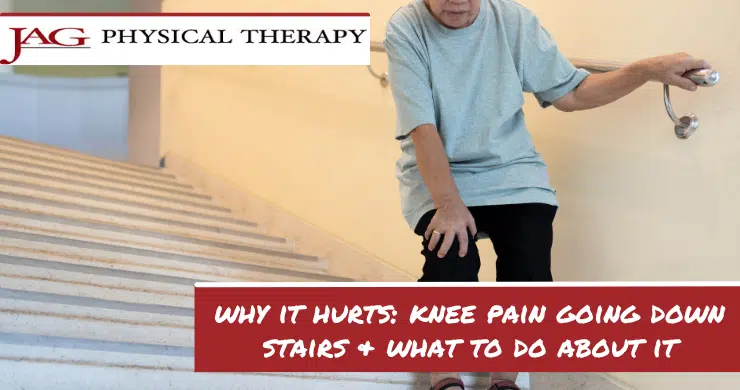
WHY IT HURTS: KNEE PAIN GOING DOWN STAIRS & WHAT TO DO ABOUT IT
You make it up the stairs without much trouble. Then you turn around, take a few steps down, and there it is: that ache behind the kneecap, a twinge along the side of the joint, or maybe a sharper pain that makes you suddenly very interested in the handrail.
It can feel backward. Shouldn’t climbing up be harder on your knees than coming down?
Surprisingly, no. The pattern of knee pain going down stairs is actually a useful clue because descending places a different kind of demand on the knee than climbing does. Your quadriceps have to control your body as you lower yourself onto the next step, while the forces between your kneecap and thigh bone increase. When something in that system isn’t moving or absorbing force well, the trip downstairs tends to expose it.
For some people, the culprit is patellofemoral pain syndrome, commonly called runner’s knee. For others, the pain may relate to IT band irritation, a meniscus problem, osteoarthritis, or weakness farther up the chain in the hips and glutes.
So if you’ve been wondering, why does my knee hurt going down stairs, understanding where the pain occurs and what happens mechanically during each step can help narrow down what may be causing it — and what you can do about it.
Key Takeaways
- Going down stairs is harder on the knee than going up. The quadriceps must control the knee eccentrically while compressive forces on the kneecap increase significantly.
- The most common cause of knee pain walking down stairs is patellofemoral pain syndrome, or runner’s knee, although IT band syndrome, meniscus irritation, and osteoarthritis can produce their own distinct patterns of stair pain.
- Pain location provides an important clue. Pain behind the kneecap points toward patellofemoral issues, outer-knee pain may indicate IT band involvement, and pain along the inner or outer joint line may be associated with the meniscus or arthritis.
- Weak hip and glute muscles are a frequently overlooked contributor. If the hip cannot stabilize the leg as you step down, the knee may end up absorbing forces that should be better distributed throughout the lower body.
- Most knee stair pain responds well to physical therapy, particularly when treatment includes hip strengthening, quadriceps retraining, and correction of movement patterns.
- Locking, giving way, significant swelling, or pain that continues to worsen without explanation are reasons to seek a physical therapy evaluation sooner rather than later.
Why Does Going Down Stairs Hurt More Than Going Up?
Going down stairs places significantly higher compressive forces on the kneecap and requires the quadriceps to work eccentrically, controlling the knee as it bends under load, which is mechanically more demanding than the concentric contraction used to climb up.
Think of your quadriceps as the brakes on the way downstairs. Instead of shortening to propel you upward, they have to lengthen while working to keep gravity from sending you down the stairs faster than planned.
Here’s what changes between the two directions:
- Going up stairs: The quadriceps contract concentrically, meaning they shorten as they generate the force needed to push your body upward. The knee is still loaded, but the muscles are working in a powerful, controlled direction.
- Going down stairs: The quadriceps work eccentrically, lengthening under load to control your descent. This creates greater demand on the muscle-tendon unit and significantly more compression between the kneecap and the femur.
- During stair descent, the patellofemoral joint, where your kneecap meets your thigh bone, absorbs force equal to roughly three to four times your body weight, approximately twice what occurs during level walking.
- That increased load helps explain why patellofemoral pain, IT band tightness, and early osteoarthritis may become especially noticeable on the way down.
This mechanical difference is why saying, “My knee hurts when going down stairs, but going up isn’t nearly as bad,” gives a physical therapist useful information. The direction that provokes the pain can help point toward which structures and movement patterns need a closer look.
The Most Common Causes of Knee Pain Going Down Stairs
Knee pain on stairs is most often associated with one of four conditions, and where you feel the pain can provide one of the clearest clues about which may be involved.
| Condition | Pain Location | Key Distinguishing Feature |
|---|---|---|
| Patellofemoral Pain Syndrome (Runner’s Knee) | Behind or around the kneecap | Aching pain on stairs, squatting, and prolonged sitting — the “movie sign” |
| IT Band Syndrome | Outer (lateral) side of the knee | Sharp or burning pain on the outer knee — often worsens with repetitive activity |
| Meniscus Irritation | Inner or outer joint line | Pain at the side of the knee — may include clicking, swelling, or feeling of catching |
| Osteoarthritis | Diffuse, often inner knee | Morning stiffness, gradual onset, worse in cold weather — common in adults 50+ |
What the Location of Your Knee Pain Is Telling You
Where your knee hurts can offer a useful clue about what may be irritated, although pain location alone cannot diagnose the problem. A physical therapist will consider it alongside your movement, strength, mobility, symptoms, and injury history.
- Behind the kneecap: Pain here commonly points toward patellofemoral involvement, where the joint between the kneecap and femur is experiencing more load than it can comfortably tolerate.
- Outer (lateral) knee: IT band irritation or the lateral meniscus may be involved. This pain tends to feel more localized than the broader ache commonly associated with patellofemoral pain.
- Inner (medial) knee: The medial meniscus, MCL, or medial compartment osteoarthritis can produce pain along the inner joint line.
- Below the kneecap: Patellar tendon irritation may be responsible, particularly in athletes whose activities involve frequent running or jumping.
Pay attention to what accompanies the pain, too. Clicking, catching, swelling, or true locking alongside joint-line pain can make meniscus or other structural involvement more concerning and worth evaluating.
Why Your Hip and Glutes Are Often the Real Problem
It is tempting to assume that a painful knee means the problem begins and ends at the knee. Bodies are less tidy than that.
Weak hip abductors and glutes are common, frequently overlooked contributors to knee pain going down stairs. Every step down briefly puts you in a single-leg position. Your hip has to stabilize the pelvis and control the position of your thigh while the knee bends and accepts your weight.
When that control is lacking, the thigh and knee may drift inward. That changes how forces travel through the knee, can increase stress around the patellofemoral joint, and may place abnormal tension on surrounding tissues. Hip strengthening is also supported as part of rehabilitation for patellofemoral pain.
This helps explain why a collection of knee exercises found online may not solve the problem. If weakness or poor control at the hip is contributing to your movement pattern, successful rehabilitation needs to address what is happening above the knee as well.
READ MORE ABOUT
HIP STRENGTHENING EXERCISES
What Helps Knee Pain Going Down Stairs — and What Makes It Worse
The most useful home strategies address the mechanics contributing to stair pain while temporarily reducing activities that repeatedly aggravate the knee. Complete avoidance is rarely the goal; restoring the knee’s capacity to handle stairs comfortably is.
What helps:
- Step down leading with the stronger leg: This temporarily reduces the eccentric demand placed on the painful knee during descent.
- Hip strengthening exercises: Clamshells, lateral band walks, and appropriately progressed single-leg exercises can target hip weakness that contributes to poor knee control.
- VMO (inner quad) activation: Straight leg raises and terminal knee extensions can help retrain quadriceps activation and control around the kneecap.
- Stair technique modification: Use the handrail, lead with the non-painful leg when necessary, and reduce step height where possible while symptoms are irritated.
- Ice after activity: If the knee feels irritated after activity, applying ice for 10–15 minutes with a barrier between the ice and your skin may provide short-term symptom relief.
What makes it worse:
- Steeper stairs, which require greater knee bend and can increase the load through the kneecap.
- Running downhill, which asks the leg to repeatedly control your descent in a way that resembles stair mechanics — only faster.
- Deep squats and lunges before the underlying cause and your current tolerance have been addressed.
- Ignoring worsening pain and repeatedly pushing through it. Pain that becomes sharper or more persistent is useful information, not a training milestone.
Exercise selection also needs context. There is a difference between progressively rebuilding the knee’s tolerance and throwing five exercises at it because five different videos promised they were the answer. The right exercise at the wrong intensity can still aggravate symptoms, which is why exercises for knee pain climbing stairs or descending them should be matched to your current strength, movement pattern, and pain response.
When Knee Stair Pain Needs a Physical Therapist
If knee pain going down stairs has lasted more than two to three weeks without improving, or your symptoms are becoming more disruptive, a physical therapy evaluation can help identify what is driving the problem rather than leaving you to keep experimenting on your own.
See a PT sooner if:
- You experience sharp knee pain going down stairs that is severe or worsening without explanation.
- The knee swells after activity or feels warm to the touch.
- The knee clicks, locks, or gives way, particularly when these symptoms are new.
- Pain has started interfering with activities beyond stairs, including walking, driving, or sleeping.
- You have already modified your activities and tried exercises without meaningful improvement.
- Symptoms began after a specific injury or incident.
What a JAG PT evaluation provides:
- Gait and movement pattern analysis to identify biomechanical factors contributing to your symptoms.
- Strength testing, with particular attention to the hips, glutes, and quadriceps.
- Functional movement screening that may include squatting, single-leg balance, and stair negotiation.
- An individualized treatment plan based on the specific factors contributing to your pain rather than a generic knee protocol.
A physical therapist can also help determine whether your symptoms warrant imaging or evaluation by an orthopedic specialist and guide that next step when appropriate. Two people can both say, “My knee hurts on the stairs,” and have very different reasons why. The evaluation is what turns that symptom into a treatment plan tailored to the person experiencing it.
Knee Pain Going Down Stairs Is Common — But It's Not Something You Have to Live With
Hip precautions depend on the surgical approach used. Patients recovering from anterior and posterior hip replacements follow different movement restrictions, and understanding those restrictions helps reduce the risk of dislocation during the early healing period.
The important part is figuring out why your knee is struggling with that particular load. Weakness in the hips or quadriceps, poor movement control, and changes in how the kneecap or surrounding tissues tolerate force can all contribute. Addressing those factors through a structured physical therapy program can help restore strength, improve movement mechanics, and make stairs feel like stairs again — rather than the part of the day you quietly dread.
JAG Physical Therapy evaluates and treats knee conditions across more than 160 locations in New Jersey, New York, and Pennsylvania. Treatment plans are individualized around each patient’s symptoms, strength, mobility, and movement patterns rather than relying on the same knee protocol for everyone.
If your knee pain walking down stairs is lingering, worsening, or changing how you move through your day, consider scheduling an evaluation with a JAG Physical Therapy clinician. Understanding the source of the problem is the first step toward getting back to stairs, running, hiking, and everyday movement with greater confidence.
START GETTING BACK
THE LIFE YOU LOVE
Knee Pain (FAQs)
Why does my knee hurt going down stairs but not up?
Going downstairs requires your quadriceps to work eccentrically, meaning the muscle lengthens while controlling your body as you descend. At the same time, greater compressive forces are placed through the kneecap than during stair ascent. This combination helps explain why conditions such as patellofemoral pain, IT band syndrome, and early osteoarthritis may become particularly noticeable on the way down.
What causes sharp knee pain going down stairs?
Sharp knee pain going down stairs may be associated with patellofemoral pain syndrome or IT band irritation, depending in part on where the pain occurs. Sharp pain accompanied by swelling, locking, catching, or the knee giving way may indicate structural involvement and should be evaluated by a physical therapist or orthopedic professional.
Can exercises help knee pain going down stairs?
Yes. Exercises that strengthen the hips, glutes, and quadriceps can address common biomechanical contributors to stair pain. Clamshells, lateral band walks, appropriately progressed single-leg exercises, straight leg raises, and terminal knee extensions may be useful depending on the cause of your symptoms.
A physical therapist can determine which areas actually need strengthening and how quickly those exercises should progress. That matters because exercises for knee pain climbing stairs or descending them are most useful when they address your particular movement pattern rather than simply adding more work to an already irritated knee.
Is knee pain going down stairs serious?
For many people, knee pain going down stairs is a treatable musculoskeletal issue and does not necessarily indicate a serious injury. However, significant swelling, locking, giving way, unexplained worsening pain, or symptoms following a specific injury warrant professional evaluation.
A physical therapist can assess whether muscular weakness, mobility, or movement mechanics appear to be contributing and determine whether further structural assessment may be appropriate.


