
HIP MOBILITY SERIES: EXERCISES TO IMPROVE FLEXIBILITY AND CONTROL
Maintaining healthy hip mobility is essential for efficient movement, athletic performance, and injury prevention. This hip mobility series highlights effective exercises to improve flexibility and control around the hip joint. Incorporating these movements into your warm-up or training routine can enhance range of motion, improve movement quality, and support overall lower-body function.
Why Does Hip Mobility Matter?
The hips are the body’s central power source for walking, running, squatting, and rotating. Having strong, mobile hips and a stable core allows runners and other athletes to move efficiently and stay more resilient to injuries down the kinetic chain. When hip mobility is limited, the lower back, knees, and ankles often pick up the slack, which can contribute to compensation patterns and increased injury risk over time. The exercises below require no equipment and can be done right on the track, in the gym, or at home.
Hip Mobility Exercises
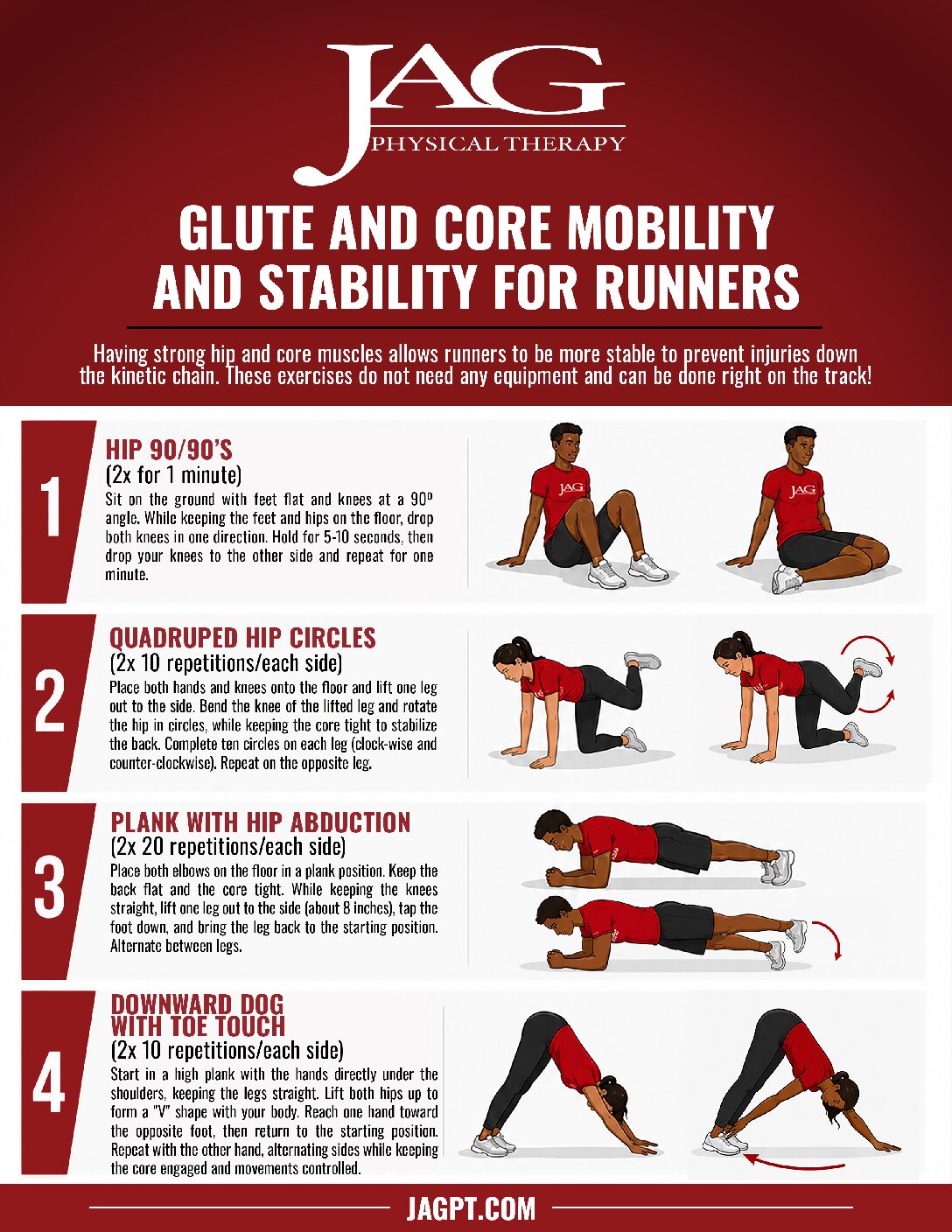
- Hip 90/90’s — Sit on the ground with feet flat and knees bent at a 90-degree angle. Keeping both feet and hips on the floor, drop both knees to one side and hold for 5–10 seconds, then drop them to the other side. Repeat for 1 minute, 2 sets.
- Quadruped Hip Circles — On hands and knees, lift one leg out to the side, bend the knee, and rotate the hip in circles while keeping the core tight to stabilize the back. Complete 10 circles clockwise and 10 counterclockwise per side, 2 sets.
Read more about Hip Mobility Exercises for Beginner Athletes.
Hip and Core Stability Exercises
- Plank with Hip Abduction — Hold a forearm plank with the back flat and core tight. Keeping the knee straight, lift one leg out to the side about 8 inches, tap it down, and return. Alternate legs for 20 reps per side, 2 sets.
- Downward Dog with Toe Touch— From a high plank, lift the hips up and back into a “V” shape. Reach one hand toward the opposite foot, then return to the starting position. Alternate sides while keeping the core engaged and movements controlled. 10 reps per side, 2 sets.
Additional Hip Flexibility and Control Exercises
- World’s Greatest Stretch — From a lunge position, drop your back knee toward the ground, place both hands inside your front foot, then take your hand that is closest to your front leg and rotate it up toward the ceiling. Repeat 5–6 times per side.
- Kneeling Hip Flexor Stretch — From a half-kneeling position, tuck your pelvis slightly and shift your weight forward until you feel a stretch in the front of the back hip. Hold 20–30 seconds, 2–3 times per side.
- Clamshells — Lying on your side with knees bent and hips stacked, keep your feet together and open your top knee like a clamshell, then lower with control. 2–3 sets of 12–15 reps per side.
- Glute Bridges— Lying on your back with knees bent, drive your hips upward by squeezing the glutes, then lower slowly. 2–3 sets of 12–15 reps to build the strength that supports control through your new mobility.
Tips for Incorporating Hip Mobility
Pair the dynamic mobility and stability drills before activity with static stretching afterward for the best overall results. As with any new exercise routine, mild muscle fatigue is expected, but pain that is sharp or persists beyond normal soreness is a sign to scale back and check in with a professional. Consistency matters more than intensity, a few focused minutes several times a week builds mobility more reliably than an occasional long session.
Move Better with JAG Physical Therapy
Better hip mobility supports better movement everywhere else in the body. If you’re dealing with hip tightness, pain, or want a mobility program built around your specific goals and activity level, schedule an appointment with JAG Physical Therapy and let our team help you move with more freedom and confidence.
EXPLORE CLINICAL OPPORTUNITIES AT JAG PT
START GETTING BACK
THE LIFE YOU LOVE