
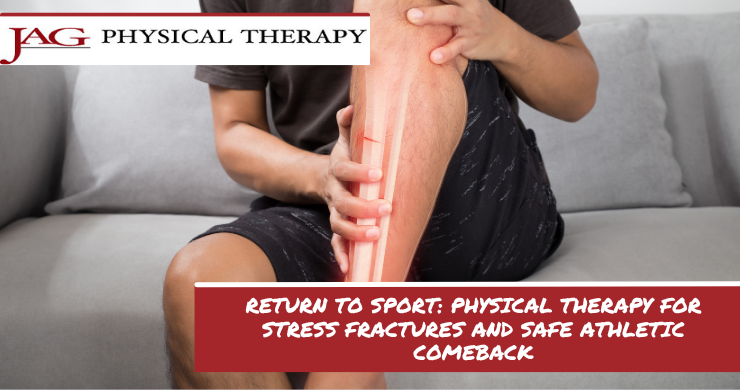
RETURN TO SPORT: PHYSICAL THERAPY FOR STRESS FRACTURES AND SAFE ATHLETIC COMEBACK
For athletes, a stress fracture is one of the most frustrating injuries to navigate. It didn’t happen from a single collision or a bad landing — it built up gradually from repetitive load, and now it’s sidelining you from the sport you’ve worked hard to compete in.
The bigger frustration is what happens next. Rest helps, but it doesn’t rebuild the strength, movement mechanics, or bone tolerance you need to return safely. Athletes who skip structured rehabilitation and rush back to training face a much higher risk of reinjury — often to the same bone.
Physical therapy gives you a structured, criteria-based path back to full activity — one that protects the healing bone while rebuilding everything rest alone can’t restore.
Key Takeaways
- Stress fractures are caused by repetitive load on bone — not a single traumatic event — and are significantly more common in athletes than the general population.
- Rest initiates healing but does not restore strength, movement efficiency, or bone tolerance. Structured physical therapy is required for a full recovery.
- Stress fracture rehab follows four progressive phases — from protection and offloading to full sport-specific reintegration.
- Return to sport is determined by criteria, not a calendar. Pain-free movement, limb symmetry, and fatigue-resistant mechanics must all be established before clearance.
- Returning too early is the leading cause of reinjury. Following your therapist’s progression is the single most important thing an athlete can do.
What Is a Stress Fracture — and Why Do Athletes Get Them?
A stress fracture is a thin crack in the bone surface caused by repetitive force — not a single traumatic impact.
Unlike acute fractures, stress fractures build up over time. The bone is subjected to repeated loading cycles faster than it can remodel and strengthen, eventually resulting in a crack. For athletes, this process is accelerated by the concentrated, high-frequency forces that training and competition place on specific areas of the body.
Common contributing factors in athletes:
- Overtraining: Increasing volume or intensity too quickly without adequate recovery time
- Poor biomechanics: Inefficient movement patterns that concentrate force on vulnerable areas
- Inadequate recovery: Insufficient rest between training sessions limits the bone’s ability to adapt
- Muscle fatigue: Fatigued muscles transfer more impact directly to bone rather than absorbing it
The most common sites for stress fractures in athletes are the tibia, fibula, ankle bones, and feet — making runners, dancers, and track and field athletes particularly susceptible.
Why Rest Alone Isn't Enough for a Full Return to Sport
Rest is essential for healing — but it cannot restore what the injury took away.
Most athletes measure recovery by how they feel. When the pain subsides, the instinct is to return to training. The problem is that pain relief and full recovery are not the same thing.
What rest does not restore:
- Pre-injury muscular strength in the affected limb
- Movement efficiency and proper mechanics under load
- Bone tolerance for the forces of athletic activity
- Neuromuscular coordination and balance
- Sport-specific endurance and skill patterns
Prolonged immobilization can actually contribute to long-term weakness and movement dysfunction — which is exactly why structured physical therapy is strongly recommended for any athlete recovering from a stress fracture.
The Four Phases of Physical Therapy After a Stress Fracture
| Phase | Goals | Techniques Used |
|---|---|---|
| Phase 1: Protection & Offloading | Protect the healing bone while maintaining overall fitness | Exercises and lifestyle modifications that reduce stress on the affected bone; safe cross-training to maintain cardiovascular conditioning |
| Phase 2: Gradual Loading & Mobility | Reintroduce controlled stress to the bone and restore movement | Controlled weight-bearing progression, movement retraining to improve biomechanics and address contributing factors |
| Phase 3: Strength & Impact Preparation | Build the muscular support and bone tolerance needed for sport | Progressively loaded strength exercises targeting the core, hips, and affected limb; balance and proprioception training |
| Phase 4: Return-to-Sport Integration | Safely reintegrate sport-specific movement and demand | Agility drills, running progression, plyometrics, sport-specific skill building, and controlled exposure to increasing impact loads |
Your JAG PT therapist monitors your progress at every phase and advances your program based on how your body is responding — not a fixed schedule.
What Exercises Are Used in Stress Fracture Rehab?
Every patient’s recovery is different. The timeline below reflects common patterns — your therapist will advance you through each phase based on how your shoulder is healing, not a fixed calendar.
Exercise selection is individualized based on the fracture location, severity, and sport — but certain approaches are consistently effective across most cases.
Early and middle phases typically include:
- Low-impact strength and endurance work targeting the core, hips, and lower extremities to improve force distribution during running and jumping
- Balance and proprioception training to rebuild the movement mechanics that protect the bone under load
- Gradual intensity progression — walking before jogging, jogging before running, with controlled increases in duration and pace
Later phases introduce:
- Plyometric exercise as bone healing is confirmed and load tolerance is established
- Sport-specific drills that replicate the demands of your particular activity
- Fatigue-based training to confirm that mechanics hold up under game-like conditions — not just in a rested state
How Physical Therapists Determine Readiness to Return to Sport
Return-to-sport clearance is based on specific physical criteria — not how long it has been since the injury.
Before recommending a return to full training and competition, your JAG PT therapist will assess:
Pain-free movement
All sport-related movements performed without pain at full intensity.
Strength symmetry
The injured limb matches the uninjured side within an acceptable threshold.
Fatigue-resistant mechanics
Correct movement patterns maintained even when physically tired – not just when fresh.
Load tolerance
The affected bone and surrounding tissue handle progressive impact without symptoms.
Sport-specific function
Movement patterns specific to your activity – including water movement for swimmers or cutting mechanics for field sport athletes – performed at full demand.
Meeting all criteria matters. Clearing one or two without the others is not sufficient for safe return.
Common Mistakes Athletes Make During Stress Fracture Recovery
The leading cause of reinjury is returning to sport before the body is actually ready — and it happens more often than it should.
Other mistakes that derail stress fracture recovery:
- Ignoring subtle pain signals during rehab, dismissing them as normal training fatigue rather than reporting them to your therapist
- Skipping rehabilitation phases because symptoms have improved and the injury feels resolved
- Completing rehab correctly but neglecting biomechanics — if the movement patterns that contributed to the fracture aren’t corrected, the same bone is at risk again
- Training through cross-training limits — pushing too hard in low-impact activities during the protection phase compromises bone healing
- Returning without sport-specific testing — performing well in the clinic doesn’t automatically mean you’re ready for the demands of competition
The most effective protection against all of these is a physical therapist you trust — and a commitment to following the program fully.
Get Back to the Sport You Love With JAG PT
A stress fracture doesn’t have to define your season — or your athletic future. With structured, criteria-based rehabilitation guided by experienced sports physical therapists, most athletes return to full training and competition without lasting limitations.
JAG Physical Therapy has helped athletes at every level — from students to professionals — recover from stress fractures and return to sport safely across more than 160 locations in New York, New Jersey, and Pennsylvania.
- 160+ locations across NY, NJ, and PA
- Experienced sports rehabilitation therapists
- Individualized programs based on your injury, your sport, and your goals
- Evidence-informed, criteria-based return-to-sport protocols
Book your appointment now and start building the path back to the sport you love.
START GETTING BACK
THE LIFE YOU LOVE
Stress Fractures (FAQ)
How long does stress fracture rehabilitation take?
Recovery timelines vary based on fracture location, severity, and individual healing factors. Progression is criteria-based — your therapist advances you when your body is ready, not on a fixed schedule.
Can I keep training while recovering from a stress fracture?
In most cases, yes — with modification. Phase 1 of rehabilitation focuses on safe cross-training that maintains cardiovascular fitness without loading the affected bone. Your therapist determines what’s appropriate.
How do I know if I'm ready to return to sport?
Readiness is determined by physical criteria — pain-free movement, strength symmetry, fatigue-resistant mechanics, and sport-specific function — not by how much time has passed or how you feel on a given day.
What happens if I return to sport too early?
Returning before meeting clearance criteria significantly increases the risk of refracturing the same bone — which typically results in a longer, more complicated recovery than the original injury.
Do I need a referral to start physical therapy for a stress fracture?
In most cases, no. JAG PT accepts patients with and without referrals. Check with your insurance provider for specific coverage details.