BREATHING EXERCISES FOR PELVIC FLOOR
Written by Shraddha Wagh PT, DPT, PCES
Breathing plays a big role in how our muscles (especially our pelvic floor muscles) function. The diaphragm is a belly breathing muscle that works closely with our pelvic floor, core, and deep back to regulate pressure and maintain postural control. Breathing effectively can reduce tension, aid in healing, and improve coordination.
Below are some general breathing exercises in various positions. Remember that each body is different! A licensed pelvic floor PT can provide you with further individualized exercises based on individualized needs
360 Breathing
Use: general deep breathing, pelvic floor relaxation , full body relaxation
Position: lay on your back with your knees bent or place a pillow beneath the knees to relieve pressure off the back
- Place 1 hand on your ribs underneath the chest and 1 hand on your abdomen.
- Take a deep inhale through your nose for a count of 3-4. As you inhale, the ribs should move outwards in a bucket handle pattern, and the abdomen should rise. With a deep breath in, the diaphragm will move down and allow your pelvic floor muscles to “drop” or relax.
- Slowly exhale through the mouth as if you are blowing out a candle. As you exhale, your ribs and belly should return to starting position.
Frequency: perform this deep breathing exercise for 2-3 mins daily or as needed.
LEARN MORE ABOUT
PELVIC HEALTH EXERCISES
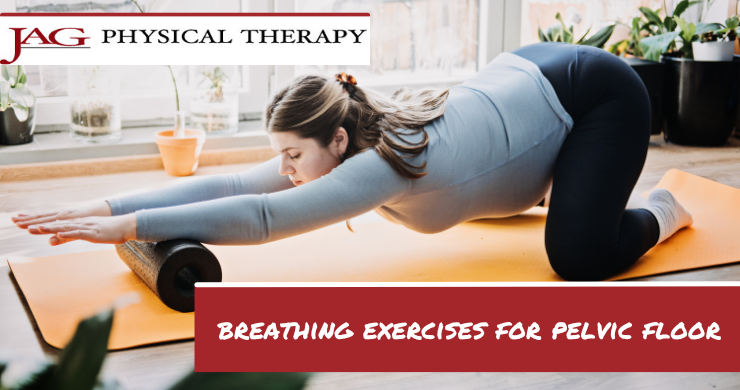
Back-Body Breathing over Ball
Use: relax the back muscles, useful during pregnancy and labor, allows you to practice breathing through the back and ribcage muscles.
Position: Lean your upper body forward over a therapy ball, pillows, or a table. Rest your arms and head comfortably. Ensure your feet are flat on the floor.
- Gently inhale through your nose. Feel your breath expand into your back and feel the ribcage widen out to the side.
- Let the belly soften and let the pelvic floor relax.
- Exhale slowly through the mouth. Let the body gently return to the starting position.
Frequency: 2-3 mins daily, or 8-10 slow breaths.
Side Lying Breathing
Use: improve breathing through the ribcage.
Position: lay on your side with your head and neck supported by a pillow. Bend the knees slightly and stack your hips. Place a pillow between your knees if desired.
- Place your top hand on your ribcage.
- As you inhale slowly through your nose, feel the ribcage expand outward into your top hand and the surface/bed below you.
- Slowly exhale through the mouth and let your body return to the starting position. Use the top hand on the rib cage to gently guide the ribs down for further movement.
Frequency: 2-3 mins daily or 5-10 slow breaths on each side
Box Breathing (4-4-4)
Use: relieve stress, pelvic floor relaxation, labor, bowel movements.
Position: lay down with knees bent or sit comfortably with feet supported.
- Inhale through the nose for count of 4 seconds.
- Hold your breath for 4 seconds. Do not tighten your jaw, muscles, or glutes.
- Exhale slowly through the mouth for 4 seconds.
- Hold your breath for 4 seconds before repeating again.
- Tip: as you do this, visualize a square and imagine each step traveling to each side of the box. If 4 seconds is too difficult, start with 2 or 3 seconds and progress towards 4 seconds.
Frequency: 2-3 mins daily or 8-10 slow breaths
All of these breathing exercises can be performed in isolation or in combination with various stretches and mobility exercises to further enhance flexibility and relaxation. Try to practice these techniques regularly for mindfulness and combine with exercise and daily activities when possible. Over time, these exercises can help your body develop healthier and more natural movement patterns.
Remember to start slowly and go at your own pace – stop if you feel dizzy or uncomfortable. Avoid straining. If you feel any pain or discomfort, contact your primary care physician or pelvic floor PT.
With consistent practice, these simple techniques can support better breathing and overall well-being.
START GETTING BACK
THE LIFE YOU LOVE