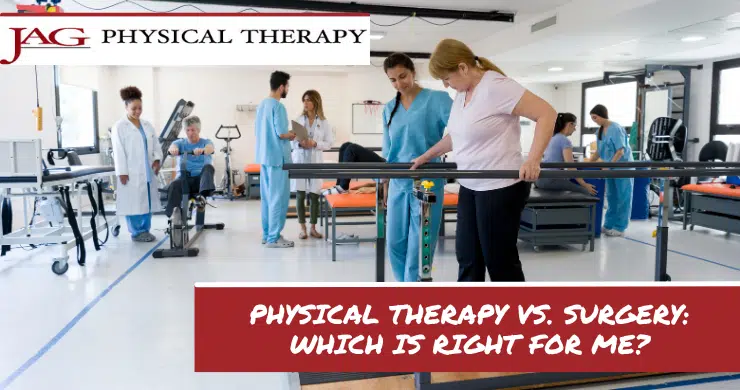
PHYSICAL THERAPY VS. SURGERY: WHICH IS RIGHT FOR YOU?
A diagnosis that puts surgery on the table is rarely a simple moment. For most people, it triggers a flood of questions — how serious is this really, what happens if I don’t get the operation, what does recovery look like, and is there another way?
The answer, for a significant number of musculoskeletal conditions, is yes. Physical therapy is the evidence-based first-line treatment for many of the most common joint, muscle, and structural conditions — and for patients who receive the right PT care early, surgery is often delayed, sometimes avoided entirely, and always better prepared for when it is necessary.
Understanding where you fall on that spectrum starts with understanding what each option actually involves — and what the research says about when each one works best.
Key Takeaways
- Physical therapy is the recommended first-line treatment for most musculoskeletal conditions — major medical associations consistently support conservative care before surgery for the majority of joint, soft tissue, and structural injuries.
- Many conditions that patients assume require surgery — certain back pain presentations, joint arthritis, rotator cuff tears, and meniscus injuries — respond well to structured PT without an operation.
- Surgery becomes the clearer choice when there is severe structural damage, complete tears, significant joint instability, or failure to progress with conservative care after a genuine effort.
- Pre-operative PT — sometimes called prehabilitation — consistently improves surgical outcomes by building strength and function before the procedure, leading to faster post-op recovery.
- Post-operative PT is not optional — it is the primary driver of what you get back after surgery. The quality of your rehabilitation determines your final outcome as much as the surgery itself.
- The decision between PT and surgery should never be made without input from both a physical therapist and a physician — both perspectives are necessary for an informed choice.
When Physical Therapy Is the Right First Step
Physical therapy is the appropriate first-line treatment for the large majority of musculoskeletal conditions — and in many cases, it is the only treatment patients need.
This is not a conservative or cautious position. It reflects the consensus of major orthopedic and physical medicine associations, which consistently recommend conservative care before surgical intervention for most joint, soft tissue, and overuse conditions. The musculoskeletal system responds meaningfully to structured loading, movement retraining, and manual therapy — often achieving outcomes that surgery would have aimed for.
Conditions that frequently respond well to PT alone include:
- Back pain and spine conditions: The majority of back pain — including disc herniations, facet joint dysfunction, and many cases of spinal stenosis — improves significantly with structured PT. Some patients with scoliosis can avoid surgical correction using the Schroth method, a specialized PT approach designed specifically for scoliosis management
- Joint pain and arthritis: Hip, knee, and shoulder arthritis frequently responds to strengthening the muscles that support and offload the affected joint — reducing pain and restoring function without replacing the joint
- Rotator cuff injuries: Many partial rotator cuff tears respond well to PT-based strengthening and movement retraining without surgical repair
- Meniscus tears: Particularly in adults over 40 with degenerative tears, PT-based management produces outcomes comparable to surgery in multiple clinical trials
- Soft tissue injuries: Muscle strains, ligament sprains, and tendinopathies typically heal with structured loading and progressive exercise rather than surgical intervention
- Stress fractures and overuse conditions: Activity modification, load management, and targeted strengthening address the underlying mechanical causes
The key is that physical therapy addresses the root cause of symptoms — not just the pain — through techniques that build strength, restore range of motion, correct movement mechanics, and reduce inflammation over time.
BOOK AN EVALUATION AT JAG PT
When Surgery Is the More Appropriate Choice
Physical therapy cannot replace every structural repair the body needs — certain injuries and conditions require surgical intervention before rehabilitation can be effective.
The clearest cases for surgery involve severe structural damage that the body cannot repair through conservative means alone:
- Complete ligament tears:A fully ruptured ACL, for example, does not regenerate on its own. Surgical reconstruction followed by PT rehabilitation is the standard of care for athletes and active individuals who want to return to cutting and pivoting sports
- Complete tendon ruptures: A fully torn Achilles tendon or quadriceps tendon requires surgical reattachment before PT-based strengthening can begin
- Multipart fractures: Complex fractures involving displaced bone fragments require surgical fixation — plates, rods, or screws — to restore the structural alignment that healing depends on
- Advanced joint degeneration: When cartilage loss is severe and daily function is significantly compromised, joint replacement restores the surface that PT cannot rebuild
- Spinal cord compression: When nerve compression from disc herniation or spinal stenosis produces progressive neurological deficits — weakness, numbness, loss of bowel or bladder function — surgical decompression becomes urgent
- Significant joint instability: When ligamentous instability prevents safe, functional movement despite PT and bracing, surgical stabilization may be required
- Failure to progress with conservative care: Patients who complete a legitimate course of PT without meaningful improvement may be experiencing a structural issue that PT cannot resolve — at which point surgical evaluation becomes the appropriate next step
The important word in that last point is “legitimate.” A four-session course of therapy is not a fair trial of conservative care. Most meaningful PT programs require 6–12 weeks of consistent treatment before a realistic assessment of progress can be made.
How Physical Therapy Helps You Avoid or Delay Surgery
For conditions where surgery is possible but not immediately necessary, physical therapy can make the difference between an operation that happens soon and one that may never need to happen at all.
PT-based avoidance of surgery works through several interconnected mechanisms:
- Joint stabilization: Strengthening the muscles surrounding a joint reduces the mechanical stress on the damaged structure itself — allowing function to improve without requiring repair of the underlying damage
- Load redistribution: Improving movement mechanics changes how force travels through the musculoskeletal system, offloading damaged areas and reducing pain signals
- Inflammation management:Manual therapy, therapeutic modalities, and targeted exercise reduce chronic inflammatory processes that drive many pain conditions
- Neuromuscular retraining: Restoring proper muscle firing patterns and movement coordination allows patients to function safely with structural changes that imaging shows but symptoms may not reflect
- Long-term maintenance: A consistent home exercise program maintains the gains made in PT — extending the window of function without surgical intervention
The multi-specialty approach at JAG PT is particularly effective for this purpose — combining orthopedic, manual, and movement-based PT modalities to address all contributing factors simultaneously rather than treating each in isolation.
How Physical Therapy Supports Surgery When It Is Necessary
Physical therapy benefits nearly every type of runner, from beginners to competitive athletes. It’s especially valuable for people increasing mileage quickly, chasing a personal record, or returning to running after an injury or time off.
When surgery is the appropriate choice, physical therapy improves outcomes on both sides of the operating room — and the research on this is consistent.
Pre-Operative Physical Therapy (Prehabilitation)
Patients who complete structured pre-operative PT consistently demonstrate faster post-surgical recovery, shorter hospital stays, and better functional outcomes than those who proceed directly to surgery.
What prehabilitation accomplishes:
- Builds muscular strength and endurance before surgery — the stronger a patient enters the operating room, the stronger they emerge on the other side
- Establishes movement patterns and exercises the patient will use in post-operative PT — removing the learning curve from the recovery phase
- Reduces post-operative pain and swelling by improving baseline tissue health
- Addresses any compensatory movement patterns that could complicate post-surgical rehabilitation
For patients with a scheduled surgery date, beginning PT immediately — rather than waiting — is strongly recommended.
Post-Operative Physical Therapy
The quality of post-operative PT determines what a patient actually gets back from their surgery — the operation creates the possibility of recovery, but PT is what turns that possibility into function.
Post-operative PT at JAG PT addresses the full recovery arc:
- Early phase: Swelling and pain management, protected mobility, and activating the muscles that shut down after surgery
- Middle phase: Progressive strengthening, range of motion restoration, gait normalization, and scar tissue management using specialized techniques including the Graston method
- Late phase: Functional movement retraining, return to daily activities and work, and sport-specific rehabilitation for athletes
- Long-term: Education and home exercise programming that sustains surgical outcomes and reduces the risk of future injury or reinjury
How to Know Which Option Is Right for You
The decision between physical therapy and surgery depends on your specific diagnosis, the severity of your condition, how it affects your daily life, and how well you respond to conservative care — not on a general rule that applies to everyone.
Questions to guide your decision-making process:
- How severe are your symptoms? High constant pain or significant loss of function shifts the conversation differently than intermittent discomfort that primarily affects athletic performance
- What do imaging results show? X-rays, MRI, and CT scans reveal the structural picture — though it’s worth noting that structural findings on imaging don’t always correlate directly with functional limitations or pain levels
- Have you had a genuine PT course of PT? If you’ve completed a structured, consistent PT program with a licensed therapist and haven’t made progress, that information matters. If you haven’t tried PT yet, it should almost always come first
- Is there a structural injury that surgery is specifically designed to repair? Some injuries — complete ligament tears, certain fractures — have clear surgical indications that PT cannot address
- What are your functional goals? An elite athlete returning to cutting sport has different needs than a retiree whose goal is comfortable daily walking
This decision should be made in close consultation with both a physical therapist and a physician. Both perspectives are necessary. A physical therapist can assess your functional capacity, movement quality, and realistic potential for conservative recovery. A physician — particularly an orthopedic specialist — can assess the structural picture and surgical options. Together, they give you the most complete information available.
Start With a Physical Therapy Evaluation at JAG PT
For most musculoskeletal conditions, a physical therapy evaluation is the right first step — not because surgery is always avoidable, but because understanding your functional baseline and rehabilitation potential gives you better information for every decision that follows.
JAG Physical Therapy has helped countless patients across New York, New Jersey, and Pennsylvania make this decision with clarity — and supported them through whatever came next. Whether the outcome is successful conservative recovery, optimized preparation for surgery, or comprehensive post-operative rehabilitation, the goal is always the same: the best possible long-term function for your body and your life.
- 160+ locations across NY, NJ, and PA
- Pre- and post-operative PT as a top clinical specialization
- Individualized, multi-specialty treatment plans
- Experienced therapists who have guided patients through every stage of this decision
START GETTING BACK
THE LIFE YOU LOVE
Running Injuries (FAQs)
How do I know if I need surgery or physical therapy?
The decision depends on your specific diagnosis, symptom severity, functional limitations, and imaging results. For most musculoskeletal conditions, physical therapy is the appropriate first-line treatment. Surgery becomes the clearer choice when there is severe structural damage, complete tears, neurological compromise, or failure to progress with a genuine course of conservative care.
Can physical therapy help me avoid surgery?
For many conditions — including certain rotator cuff tears, meniscus injuries, joint arthritis, and back pain — yes. PT addresses the root mechanical causes of pain and functional limitation, and many patients achieve lasting improvement without surgical intervention. The earlier PT begins, the better the opportunity to avoid or delay an operation.
What is prehabilitation and does it actually help?
Prehabilitation is structured PT completed before a scheduled surgery. Research consistently shows that patients who complete prehab enter surgery stronger, recover faster, spend less time in post-acute care, and achieve better long-term functional outcomes than those who proceed directly to surgery. If surgery is scheduled, beginning PT immediately is strongly recommended.
How long does post-operative physical therapy take?
Post-operative PT timelines vary by procedure and individual healing. Minor soft tissue surgeries may require 6–8 weeks of PT. Major joint replacements typically involve 3–6 months. ACL reconstruction and complex joint surgeries often require 9–12 months of structured rehabilitation. Your JAG PT therapist will establish a realistic timeline based on your specific surgery and recovery progress.
Do I need a referral for physical therapy?
In most cases, no. JAG PT accepts patients with and without referrals. If you’re trying to determine whether surgery is necessary, a PT evaluation can be a valuable first step regardless of whether you have a physician referral. Check with your insurance provider for specific coverage details.