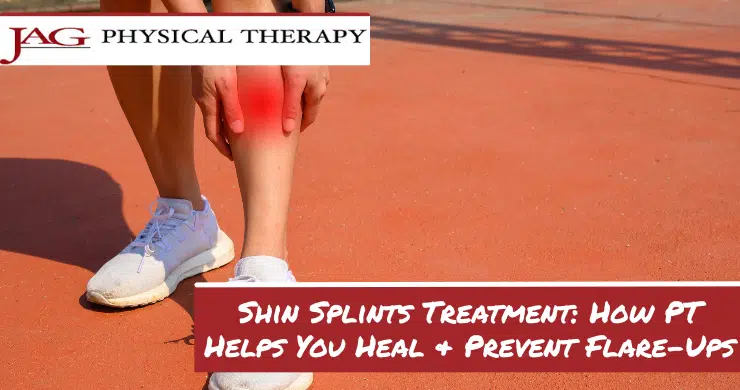
SHIN SPLINTS TREATMENT: HOW PHYSICAL THERAPY HELPS YOU HEAL AND PREVENT FLARE-UPS
Shin splints treatment with physical therapy focuses on calming irritated tissue while correcting the calf stiffness, hip weakness, and running mechanics that overload the shinbone. Mild cases often improve within two to four weeks of load management and targeted strengthening, while more stubborn cases may take six to twelve weeks.
Key Takeaways:
- Shin splints are a mechanical overload issue, not just a surface bruise: Shin splints develop when repetitive impact and muscle pull stress the shinbone and its lining faster than the tissue can recover.
- Rest alone rarely prevents a recurrence: Taking time off calms symptoms, but returning to activity without addressing calf stiffness, hip weakness, or running form makes it more likely the pain will come back.
- Physical therapy targets the root cause of stress: A personalized evaluation helps identify what is driving excess load into your lower leg, from foot mechanics to poor pelvic stability.
- Progressive loading rebuilds tissue tolerance: Shin splints treatment often pairs hands-on soft tissue work with targeted strengthening so your bones and tendons can better absorb shock.
You lace up your running shoes or step onto the field, and within minutes, a familiar dull ache creeps along the inner edge of your lower leg.
If you’ve tried taking time off, buying new sneakers, or stretching before every run, only to have the same pain return, you’re not alone. Shin splints are one of the most frustrating injuries for runners, athletes, and active adults because rest only pauses the symptoms. Unless you change how your body absorbs impact, your shins take the same beating once you start moving again. Effective shin splints treatment finds out why your lower legs are taking on too much shock and retrains your body to share the load.
What Are Shin Splints and Why Do They Happen?
Shin splints, clinically known as medial tibial stress syndrome (MTSS), are an overuse injury caused by repetitive stress on the tibia (shinbone) and the tissue that attaches muscle to bone. They develop when the impact of running, jumping, or brisk walking exceeds your lower leg’s ability to recover.
Several deep muscles, including the soleus and tibialis posterior, run along the inner edge of your tibia and help control your arch and ankle each time your foot lands. When these muscles get tired, tight, or overloaded by a spike in training, they pull repeatedly on the periosteum, the thin layer of tissue covering the shinbone. Over time, this stress can irritate the periosteum and lead to stress reactions in the bone itself.
Common triggers that push your tissues past their tolerance threshold include:
- Rapid training spikes: Increasing weekly mileage, sprinting intensity, or hill work gives bone and tendon tissue too little time to adapt.
- Sudden surface or footwear changes: Transitioning abruptly from soft turf or a treadmill to concrete sidewalks, or running in worn-out shoes, amplifies impact forces.
- Lower-body muscle imbalances: Tight calves can restrict ankle motion and cause the foot to roll inward excessively, while weak hips can allow the knee to cave inward and twist the lower leg with every stride.
READ MORE ABOUT
HOW TO PREVENT
RUNNING INJURIES
How Can You Tell Shin Splints Apart from Other Lower-Leg Injuries?
Shin splints typically cause a broad ache that spans at least a couple of inches along the inner edge of the lower two-thirds of the shinbone. Other lower-leg conditions feel different, and recognizing the differences helps you get the right care before an irritation turns into a season-ending injury:
- Tibial stress fracture: Sharp pain in one spot on the bone that worsens with running, lingers at rest, and may throb at night.
- Chronic exertional compartment syndrome: Tightness or pressure in the front or outer lower leg that builds during exercise and eases when you stop, sometimes with foot numbness or tingling.
- Posterior tibial tendinitis: Aching behind the inner ankle bone and into the arch, often with swelling or a flattening arch.
If your symptoms sound more like a stress fracture or tendinitis, a physical therapist can help you figure out what’s causing your pain and the right next step.
How Physical Therapy Treats Shin Splints
Physical therapy treats shin splints by combining targeted pain relief with a full-body assessment that addresses the movements overloading your tibia. At JAG Physical Therapy, clinicians look past the sore spot on your lower leg to examine how your hips, knees, ankles, and feet work together.
Comprehensive Gait and Movement Evaluation
Your recovery begins with a detailed look at how you move. A physical therapist evaluates how far your knee can travel forward over your toes, foot arch mechanics, hip abductor strength, and single-leg balance. If you are a runner or field athlete, a video gait analysis can reveal subtle habits you cannot feel on your own, such as overstriding or a crossover step that adds stress to the tibia.
Hands-On Manual Therapy and Tissue Recovery
When deep lower-leg muscles become chronically tight, foam rolling alone often isn’t enough. Your therapist may use targeted manual therapy techniques, such as myofascial release, instrument-assisted soft tissue mobilization, or joint mobilizations at the ankle, to restore tissue glide. Reducing stiffness in the calf can help ease tension along the inner shin.
Progressive Strengthening and Neuromuscular Retraining
Once acute soreness settles, therapy shifts toward building resilience. Strengthening the calf, foot, and lateral hip muscles trains your body to absorb shock more effectively.
3 Physical Therapy Exercises to Build Shin Resilience
Rebuilding lower-leg tolerance requires strengthening both the muscles that decelerate your foot strike and the hip stabilizers that keep your leg aligned. Check with your physical therapist before starting, and stop any exercise that causes sharp pain during or after your session.
1. Bent-Knee Calf Raises (Soleus Strengthening)
The soleus muscle handles forces of up to about eight times your body weight during running and attaches along the inner tibia.
- How to do it: Stand facing a wall with your fingertips resting for balance. Bend both knees to roughly 30 degrees and hold that slight squat throughout the movement. Slowly rise onto the balls of your feet for two seconds, pause at the top, and lower your heels back down slowly.
- Form cue: Keep your weight centered over the base of your big toe and second toe so your ankles do not roll outward at the top.
- Reps: 3 sets of 12 to 15 repetitions.
2. Banded Ankle Inversion and Dorsiflexion
Strengthening the tibialis posterior and tibialis anterior prepares these muscles to support your arch and keep your foot from collapsing as fatigue sets in.
- How to do it: Sit on the floor with your legs extended. Loop a resistance band around the ball of your right foot and anchor the other end to a sturdy object on the outside of that foot. Slowly turn your right foot inward against the band’s resistance, then return to neutral with control. Next, anchor the band in front of you and pull the top of your foot toward your shin.
- Form cue: Isolate the motion at your ankle joint rather than rotating your entire thigh or knee inward.
- Reps: 3 sets of 15 slow repetitions in each direction.
3. Single-Leg Step-Downs (Hip and Knee Alignment)
Weakness in the gluteus medius can let your thigh rotate inward on impact, twisting the shinbone below it.
- How to do it: Stand on a sturdy step on your affected leg, hands on your hips. Slowly hinge at the hips and bend your standing knee to tap your opposite heel lightly on the floor in front of the step, then press through your standing heel to return upright.
- Form cue: Watch your standing kneecap in a mirror and keep it tracking over your second toe without caving inward.
- Reps: 3 sets of 10 repetitions per side.
How Can You Prevent Shin Splints from Returning?
Preventing shin splints from flaring up again comes down to managing how quickly you load your lower legs and maintaining calf and hip strength. Once your pain subsides, follow these habits to protect your shins during training cycles:
- Follow a gradual return-to-run progression: Start with walk-jog intervals on flat surfaces before reintroducing speed work, hills, or steep downhill running. A structured return-to-sport program can help you progress safely.
- Increase your running cadence slightly: Taking slightly shorter, quicker steps helps prevent overstriding and can reduce the load on your shinbone with each landing.
- Rotate and replace athletic footwear: Running shoes are generally recommended to be replaced every 300 to 500 miles, as the midsole foam loses cushioning over time.
Learn more about our return-to-sport program.
When Should You See a Physical Therapist for Shin Pain?
You should schedule a physical therapy evaluation if shin pain lasts longer than one to two weeks of rest, changes how you walk or run, or interferes with your daily activities. Early intervention can help keep minor irritation from progressing into a stress reaction or a full tibial stress fracture.
Seek a professional assessment right away if you notice any of the following symptoms:
- Pain that persists during casual walking, standing, or climbing stairs
- Sharp, focal tenderness when you press onto one exact spot along the shinbone
- Visible swelling, redness, or warmth over the bone
- Aching or throbbing in your lower leg at night or when resting in bed
- Numbness, tingling, or foot weakness during or immediately after exercise
Get Back to Running With JAG Physical Therapy
Shin splints are more than a minor nuisance to push through; they’re a signal that your lower legs are absorbing more stress than your muscles and bones can handle.
At JAG Physical Therapy, our clinicians take a personalized approach to uncovering the cause of your shin pain across our 190+ locations throughout New Jersey, New York, and Pennsylvania. By pairing hands-on manual therapy with targeted strengthening and gait retraining, we build a recovery plan tailored to your sport, lifestyle, and goals. With the right clinical guidance, you can build lasting lower-leg resilience and work toward running, training, and moving without pain.
Frequently Asked Questions About Shin Splints Treatment
Should I stretch my calves if I have shin splints?
Gentle calf stretching can ease stiffness, but aggressive stretching can irritate the tissue further. Since shin splints stem from repeated stress on the shinbone, slow, bent-knee calf strengthening often does more to build resilience than static stretching alone.
Can I keep running while recovering from shin splints?
You can often continue modified activity if pain remains mild, doesn’t worsen during your workout, and resolves within 24 hours. If it alters your stride, sharpens on impact, or lingers while walking afterward, switch to low-impact training like swimming, cycling, or aquatic therapy until a physical therapist clears you.
Do compression sleeves or orthotics cure shin splints?
Compression sleeves and arch inserts may help reduce strain on your inner shin, but they are not a permanent fix. Pairing supportive footwear with physical therapy builds the foot, calf, and hip strength your body needs to support itself without relying on gear.
How long does it take for shin splints to heal with physical therapy?
Mild cases of shin splints often improve within two to four weeks of targeted load management and physical therapy, while more stubborn cases may take six to twelve weeks. Your timeline depends on how long symptoms have been present, whether a bone stress reaction has developed, and how consistently you follow your strengthening plan.
START GETTING BACK
THE LIFE YOU LOVE