THE CAT-COW STRETCH: WHY PHYSICAL THERAPISTS SWEAR BY IT – AND HOW TO DO IT RIGHT
The cat-cow stretch earns its place in physical therapy because it accomplishes what few single exercises can: combining spinal mobility, core activation, disc health, and postural control into one gentle movement.
At JAG Physical Therapy, cat-cow is one of many evidence-based exercises our clinicians prescribe in customized home exercise programs. Whether you are recovering from an injury or managing daily desk stiffness, our therapists across 160+ locations in NY, NJ, and PA provide hands-on form evaluation to ensure you get the maximum clinical benefit from every movement.
Key Takeaways:
- Segmental spinal mobility: Cat-cow moves each vertebra through full flexion and extension in a slow sequence rather than as a single rigid unit.
- Multifaceted benefit: Simultaneously addresses spinal mobility, core activation, postural awareness, and intervertebral disc health.
- Movement initiation: Correct form requires initiating movement from the spine itself rather than driving from the hips or shoulders.
- Seated accessibility: A seated modification delivers comparable spinal mobility benefits for patients who cannot get onto the floor.
- Prenatal support: Relieves lumbar pressure, improves pelvic awareness, and accommodates postural changes across all trimesters.
- Individualized care: JAG Physical Therapy prescribes cat-cow as part of tailored home exercise programs across NY, NJ, and PA.
What Does the Cat-Cow Stretch Actually Do? The Clinical Explanation
The cat-cow stretch produces controlled, segmental spinal mobility, moving the spine through full flexion and extension in a way most people rarely achieve during everyday activity.
- Segmental spinal movement: The spine consists of 33 vertebrae. Prolonged sitting and inactivity cause certain segments to stiffen while others compensate with excessive movement. Cat-cow encourages every segment to participate, restoring even mobility distribution.
- Intervertebral disc health: Spinal discs lack a direct blood supply and depend on movement-driven fluid exchange for nutrients. The alternating compression and decompression of cat-cow facilitates this fluid exchange, supporting disc hydration.
- Deep core activation: The “cat” position activates deep core stabilizers like the transverse abdominis, while the “cow” position engages the multifidus and erector spinae. This makes it an ideal exercise for early-stageback rehabilitation.
- Proprioceptive awareness: Moving slowly through the range trains the nervous system to sense and control spinal positioning, rebuilding postural awareness diminished by chronic pain.
Learn more: Herniated Disc Exercises to Relieve Back Pain
Learn more: How to Strengthen Your Core Without Hurting Your Back
Cat-Cow Stretch Benefits — Why Physical Therapists Prescribe It Across So Many Conditions
The cat-cow stretch addresses multiple physical health factors simultaneously in a single, low-impact movement.
| Benefit | What It Addresses | Who Benefits Most |
|---|---|---|
| Spinal Mobility | Restores segmental flexion and extension throughout the thoracic and lumbar spine | Adults with low back stiffness, desk workers, post-surgical patients |
| Low Back Pain Relief | Reduces muscular tension and improves fluid circulation in spinal structures | Patients with chronic low back pain, disc irritation, early morning stiffness |
| Core Activation | Engages transverse abdominis (cat) and multifidus/erector spinae (cow) in a coordinated pattern | Back pain rehabilitation, postpartum patients, athletes |
| Postural Awareness | Trains proprioception and spinal control to improve neutral posture recognition | Desk workers, adolescents with postural habits, older adults |
| Disc Health | Facilitates fluid exchange in avascular disc tissue through alternating loading | Adults with disc issues, sedentary patients, prolonged sitters |
| Prenatal Comfort | Relieves lumbar pressure, improves pelvic awareness, and supports changing center of gravity | Pregnant patients in any trimester |
How to Do the Cat-Cow Stretch — Step-by-Step Instructions With Proper Form Cues
Perform this movement on hands and knees, ensuring movement initiates from the spine rather than forcing position from the hips or shoulders.
Starting position:
- Begin on hands and knees with wrists directly under shoulders and knees directly under hips.
- Maintain a neutral spine: neither arched upward nor drooping downward.
- Keep your head in line with the spine, looking at the floor.
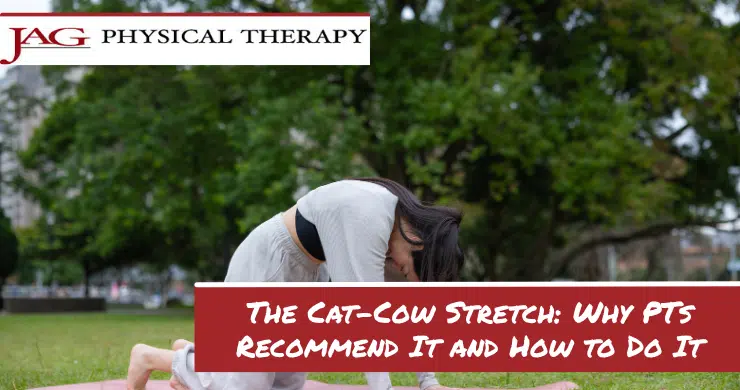
The Cat (spinal flexion):
- Exhale slowly and round your spine upward, starting from the lower back and moving upward segment by segment.
- Tuck the pelvis under and gently draw the navel toward the spine.
- Allow the head to drop naturally without forcing the chin to the chest.
- Hold for one full breath.
The Cow (spinal extension):
- Inhale slowly and lower your spine, initiating from a forward pelvic tilt and moving upward through each segment.
- Allow the belly to lower gently toward the floor without collapsing into the lower back.
- Lift the head and gaze slightly forward without cranking the neck upward.
- Hold for one full breath at full extension.
Repetitions: Complete 8–10 slow, controlled repetitions, coordinating your breath with each movement.
Common Mistakes — and How to Fix Them
The most common cat-cow mistake is driving movement from the hips and shoulders rather than initiating from the spine itself.
- Driving movement from the limbs: Pushing forward and backward with the arms or hips shifts work away from the spinal segments. Keep your wrists and knees stationary and focus entirely on articulating the spine segment by segment.
- Cranking the neck upward: Forcing the chin up during the cow phase compresses the cervical spine. Keep your gaze slightly forward and allow the cervical spine to follow the rest of the movement naturally.
- Collapsing into the lower back: Letting the spine drop passively into extension dumps compressive stress directly into the lumbar facet joints. Maintain light deep core engagement to control the descent into extension.
- Rushing or holding your breath: Moving too quickly bypasses segmental control and relies on momentum. Coordinate your exhale with rounding into the cat, and your inhale with opening into the cow.
Cat-Cow Stretch Modifications — For Seated, Prenatal, and Limited-Mobility Patients
The cat-cow stretch can be modified to produce comparable spinal mobility benefits in patients who cannot get onto the floor, including seated, prenatal, and older adult variations.
Seated Cat-Cow Stretch
The seated cat-cow produces the same spinal flexion and extension pattern from a chair, making it accessible for office workers, older adults, and patients who have difficulty with floor exercises.
- Sit toward the front edge of a firm chair with feet flat on the floor, hip-width apart.
- Place your hands on your thighs for light support.
- Cat: Exhale and round the entire spine — pelvis tilts back, lower back rounds, upper back rounds, and chin drops toward chest.
- Cow: Inhale and reverse — pelvis tilts forward, lower back curves inward, chest lifts, and gaze rises slightly.
- Repeat 8–10 times — slow and coordinated with breathing.
The seated version can be performed every 1–2 hours throughout the workday to counteract the spinal compression and stiffness of prolonged sitting.
Cat-Cow During Pregnancy
Cat-cow relieves lumbar and sacral pressure, improves pelvic awareness, and supports the postural shifts that accompany a changing center of gravity during pregnancy.
- Standard cat-cow on hands and knees is appropriate throughout pregnancy — it is a non-compressive movement that does not stress the abdomen.
- In the third trimester, some patients find a wider knee position more comfortable as the belly grows — allow the belly to lower gently in cow position rather than trying to maintain tight abdominal engagement.
- Avoid deep range-of-motion if any position produces discomfort or pelvic girdle pain.
- If you have been diagnosed with symphysis pubis dysfunction (SPD) or diastasis recti, consult your PT or OB before adding any new exercise.
A Simple Exercise With a Serious Clinical Purpose — And How JAG PT Uses It
The cat-cow stretch earns its place in physical therapy because it accomplishes what few single exercises can: combining spinal mobility, core activation, disc health, and postural control into one gentle movement.
At JAG Physical Therapy, cat-cow is one of many evidence-based exercises our clinicians prescribe within customized home exercise programs. Whether you are recovering from an injury or managing daily desk stiffness, our therapists across 160+ locations in NY, NJ, and PA provide hands-on form evaluation to ensure you get the maximum clinical benefit from every movement.
START GETTING BACK
THE LIFE YOU LOVE
The Cat-Cow Stretch (FAQs)
What does the cat-cow stretch do?
The cat-cow stretch produces controlled, segmental spinal mobility by moving the thoracic and lumbar spine through flexion and extension. It simultaneously activates deep core stabilizers, aids intervertebral disc hydration, improves postural awareness, and relieves muscle tension.
What muscles does the cat-cow stretch work?
Rounding into “cat” engages the transverse abdominis and multifidus, while extending into “cow” targets the erector spinae and thoracic extensors. The movement also mobilizes deep spinal stabilizers and posterior chain fascia, serving as both a core activation and mobility exercise.
Is the cat-cow stretch good for lower back pain?
Yes. Cat-cow restores segmental mobility, relieves muscular tension, promotes disc hydration, and activates protective deep core stabilizers. It is appropriate for most lower back pain conditions when performed within a comfortable, pain-free range.
Can you do cat-cow while pregnant?
Yes. Standard cat-cow on hands and knees relieves lumbar pressure, improves pelvic awareness, and supports changing posture across all trimesters. Third-trimester patients often benefit from a wider knee stance. Consult your PT or OB first if you have SPD or diastasis recti.
What is the seated cat-cow stretch?
Seated cat-cow performs the same spinal flexion and extension pattern from a chair, making it ideal for desk workers, older adults, or anyone unable to get onto the floor. Sitting forward on a firm chair, alternate between rounding (cat) and gently arching (cow) for 8–10 breath-coordinated repetitions.